
Virtual staging disclosure: what the rule actually says
Search this topic and you will find a dozen articles telling you that a watermark is mandatory and quoting fines. Most of them are written by companies selling virtual staging, ours included. So here is the primary text, quoted from the source, and an honest account of what it does and does not require.
What the Code of Ethics actually says
The relevant obligation for a REALTOR® is Article 12, and the only place images are named is Standard of Practice 12-10:
"REALTORS® shall be honest and truthful in their real estate communications and shall present a true picture in their advertising, marketing, and other representations."
NAR Code of Ethics, Article 12
"REALTORS®' obligation to present a true picture in their advertising and representations to the public includes Internet content, images, and the URLs and domain names they use, and prohibits REALTORS® from: … otherwise misleading consumers, including use of misleading images."
Standard of Practice 12-10 (adopted 2007, amended 2018) — nar.realtor
What it does not say
It does not prescribe a watermark. It does not name virtual staging. It does not set a font size, a corner of the image, or a fine. The standard is a result, not a procedure: the image must not mislead.
That matters, because the procedural advice you will read elsewhere is not the rule itself, and individual MLS boards set their own additional requirements that genuinely do differ. Check the rules of the MLS you publish in; treat any article that speaks of one universal watermark rule (this one included) as a starting point rather than an authority.
The practical line
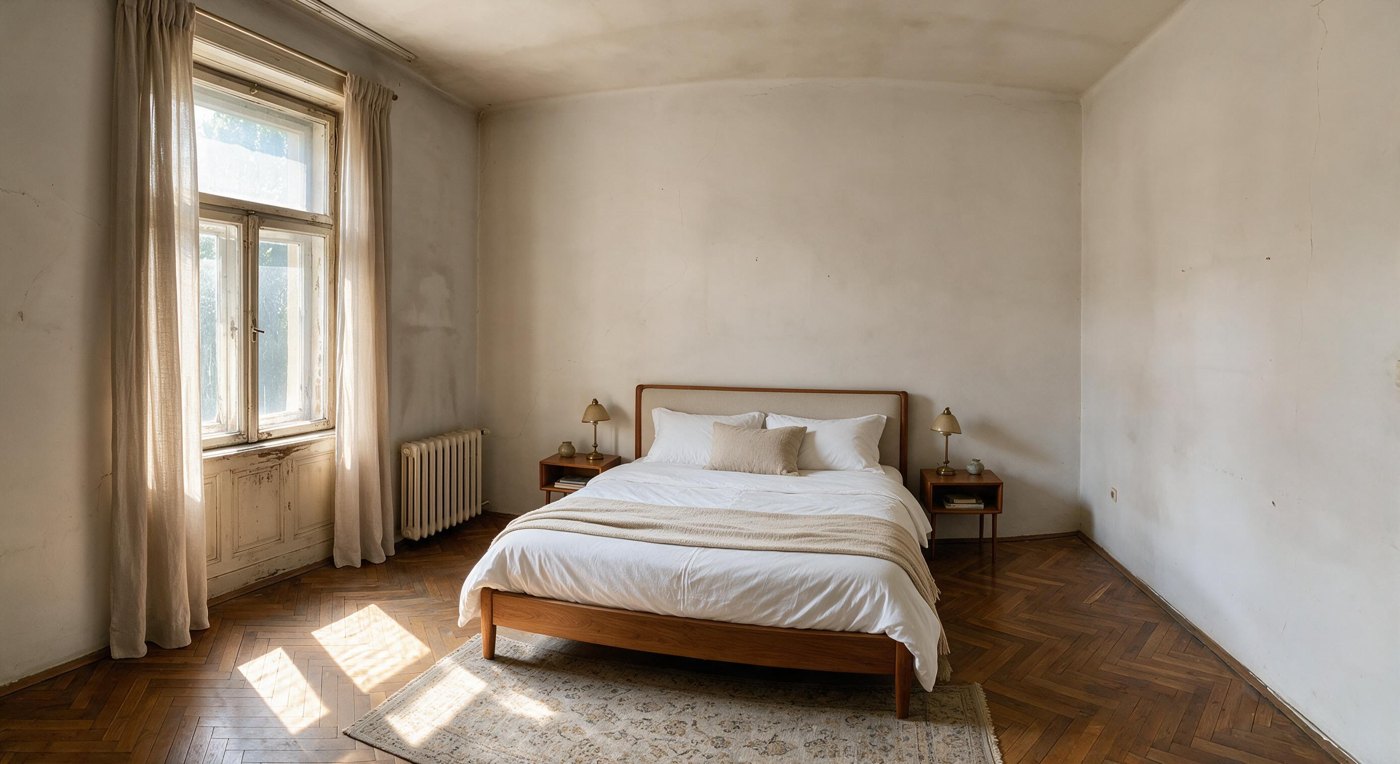
A useful working test: anything that belongs to the property must not change. Furniture is a suggestion. Structure is a fact.
- Stays exactly as photographed: floor, windows and doors, wall positions, radiators, fitted kitchen and wardrobes, tiling, the view out of the window.
- May be added: free-standing furniture, rugs, lamps, textiles, art, plants.
- Crosses the line: removing a crack or a damp patch, replacing dated tiling, stretching the room, adding a window or a balcony that does not exist, deleting a pylon from the view.
Say it in one line
"Furnishings in these images are virtually staged." Put it where the image is, not in small print at the bottom of the listing. It costs you nothing: the buyer will stand in the empty room at the viewing anyway, and the only question is whether they find out from you or from the room.
How we hold ourselves to it
We do not ask you to trust the phrasing above. Every image we produce is compared against the original before it ships, and if a fixed element of the room has changed, the image is not delivered: it is remade. The failed round is our cost, not yours.
We also refuse work that cannot be done honestly. If a photo is unusable, or the request is to remove a defect rather than to furnish a room, we say so before anything is generated.
Questions people actually ask
Is virtual staging allowed at all?
Yes. What is prohibited is a misleading image, not a furnished one. Adding furniture to an empty room and saying so is not deception; hiding the condition of the property is.
Do I have to watermark the photo?
The Code of Ethics does not require a watermark in those words. Some MLS boards do require one. Check the rules of the MLS you publish in, and when in doubt label the image anyway.
Can you remove clutter instead of adding furniture?
Yes, removing the seller's own movable belongings is the mirror image of staging and does not change the property. Removing damage is a different thing, and we will not do it.
How much is it and how long does it take?
The first image is free. After that it is 24 EUR for ten images and 49 EUR for twenty-five, net of VAT, and the finished image arrives within minutes.
Try it on your own photo
One room, staged, free, so you can judge the result on a listing you actually have.
Updated 14 August 2026. This page is an honest summary and not legal advice; the primary text is linked above. Service provided by Balog Péter e.v. (HU91829768), Hungary.